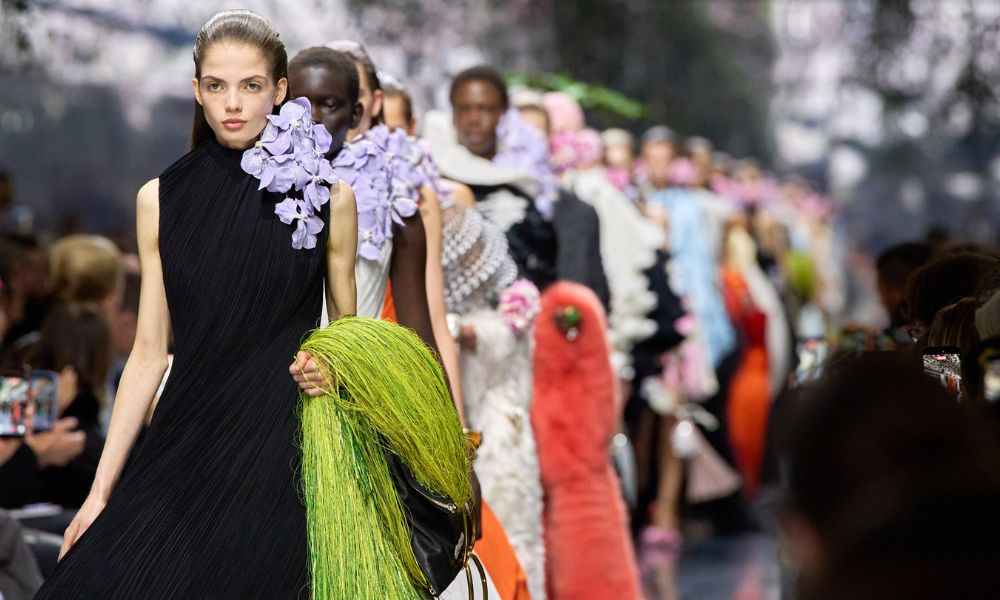
Amid the paparazzi flashes, the orchestrated fanfare, and a front row designed for maximum cultural capital at Dior’s Spring/Summer 2026 Haute Couture show, one presence mattered more than most: John Galliano. Not simply because he was there, seated quietly among the industry’s most watched faces, but because his influence ran through the collection itself. This was Jonathan Anderson’s first couture outing for Dior, and it unfolded less as a sentimental tribute.
Staged at the Musée Rodin, the show carried an immediate sense of intention. Cyclamens hovered above the space, then appeared again, more precisely, as earrings. Sculptural, graphic, and unmistakably deliberate, they framed the face with a quiet authority. These were not decorative afterthoughts. They were the emotional starting point of the collection, rooted in a moment Anderson has since shared himself.
Just before his first women’s show for Dior, Anderson invited Galliano to the studio. Galliano arrived with two small posies of cyclamen tied with black silk ribbons and, in a detail that feels telling, a bag of cakes and sweets from Tesco for the team. It was an intimate gesture, generous and unguarded. For Anderson, it was clearly very special. Those flowers became the conceptual spine of his couture debut, translated so that every model carried a version of the gift he had received.
The decision to anchor couture in something so personal speaks volumes about Anderson’s approach. Where Galliano’s Dior was built on sweeping narratives and high drama, Anderson works through symbols, systems, and craft. The cyclamen earrings crystallized that difference. They nodded unmistakably to Galliano’s late 1990s Dior, particularly the Spring 1998 collection, where florals, femininity, and historical reference collided with operatic force. Galliano’s flowers were theatrical, oversized, and charged with fantasy. Anderson’s were distilled. Close to the face, sharply executed, and structurally precise, they demanded attention without asking for it.
Jewelry, in fact, did much of the heavy lifting in this collection. The floral earrings anchored the looks, setting the tone for garments that followed the same logic. Bows appeared with purpose, reinforcing silhouette and referencing Monsieur Dior’s garden obsessions.
The clothes themselves echoed this measured respect for the archive. Self-fringed tweed tailoring subtly recalled Galliano’s historical play at Dior, but Anderson stripped it of excess. Swirls of chiffon and organza moved with ease rather than flourish. Knitwear layered over trousers introduced texture and tactility, a reminder of Anderson’s long-standing commitment to the handmade.
There were clear parallels with Galliano’s Dior beyond the floral language. Both designers understand silhouette as storytelling. Anderson’s softened references to the ‘Bar’ jacket, his manipulation of volume, and his attention to surface treatment all signaled a deep reading of the house’s codes. His couture does not reenact emotion; it contains it.
Color functioned structurally, supporting form and texture rather than overpowering them. The result felt modern without chasing novelty, rooted without feeling reverent. The debut handbag arrived quietly, confident enough not to compete with the clothes or the jewelry. It sat within the collection as an object of use rather than spectacle, reinforcing Anderson’s preference for cohesion over distraction.
The response was immediate. The front row, anchored by Galliano and Rihanna, rose for a standing ovation. What made Anderson’s first couture collection resonate was its clarity of purpose. He did not attempt to revive Galliano’s Dior nor did he sidestep it. Instead, he acknowledged that chapter through gesture, jewelry, and construction. By turning a small bouquet of cyclamens into the emotional and visual core of the collection, he demonstrated a nuanced understanding of what Dior’s legacy requires.
ALSO READ: THE LOUVRE’S STOLEN JEWELS JUST APPEARED AT THE SCHIAPARELLI COUTURE SHOW…WELL, SORT OF.