At Buro247 Middle East, we are committed to showcasing and celebrating the extraordinary talent in the Arab world. With our column, #BuroSpotlights, we bring you stories of pioneering artists, innovative designers, tech trailblazers, cinematic visionaries, sports stars, and more.
This week, #BuroSpotlights Qatari visual artist Aidha Badr.
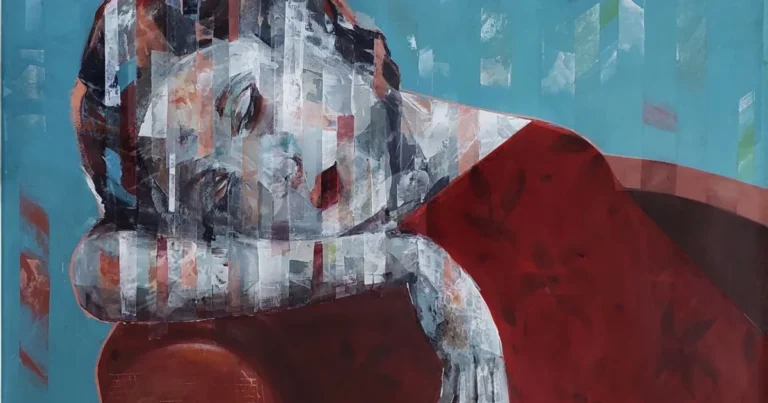
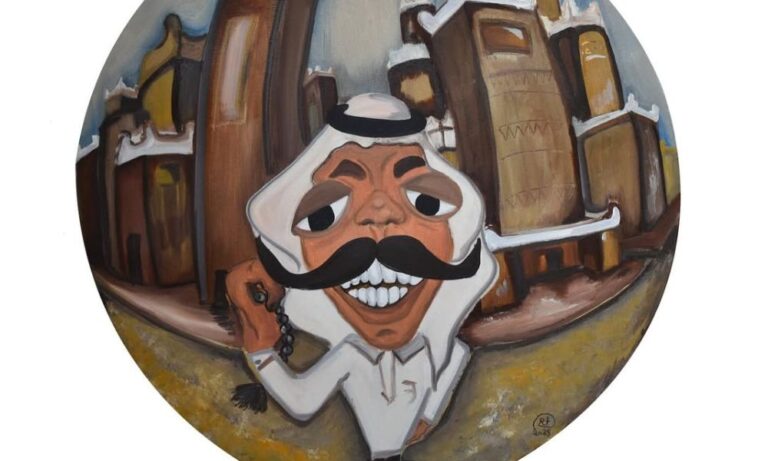
There is a quiet intensity to the way Aidha Badr brings memory to life through paintings. It is not nostalgic in the soft-focus sense, nor is it sentimental. Instead, her work sits in that uneasy space where personal history, emotional imprinting, and learned behavior collide. Looking at her paintings feels less like viewing scenes and more like stepping into a psychological archive, one where childhood recollections are fragmented, retold, and reshaped by time.
Faces and figures in her work are not about who is being represented but about what they are carrying. Her practice centers on the early realization of loss experienced in girlhood. This is not loss tied to a single event. It is structural. The moment a child begins to understand separation, absence, and the impossibility of complete emotional possession. From this point, desire becomes continuous rather than resolved. Rather than illustrating this idea literally, Badr uses memory itself as her material. Her canvases trace how longing, attachment, and emotional dependency quietly take root during girlhood, then echo into adulthood.
Memory operates as both subject and method in Badr’s paintings. She works through recollection the way one might sift through fragments rather than facts. Childhood is revisited not as a stable past but as something reconstructed over time through family narratives, repetition, and distortion. What she paints is not what happened exactly, but how it was absorbed, retold, and emotionally stored. This approach gives her work its layered quality, where personal history and shared experience overlap.
Her paintings unfold within an abstract sense of time. Scenes feel suspended, as though existing between past and present. The perspective often belongs to her younger self, but the awareness is unmistakably adult. This duality allows Badr to examine how emotional patterns form early and continue to shape adult relationships, attachment styles, and expectations placed on women. Domestic spaces, gestures, and interactions appear familiar, yet they are charged with quiet tension.
Badr’s work explores in how women learn to read emotional cues and regulate feeling. Femininity, in Badr’s world, is not decorative or symbolic. It is learned behavior. It is shaped through repetition, silence, and proximity. Her paintings reflect how emotional labor becomes internalized, how desire is often experienced alongside guilt or absence, and how longing can become a default state rather than a passing one.
Alongside her gallery practice, Badr has collaborated with fashion brands including Bloomingdale’s for a Fall/Winter collection in Kuwait and Puma for a Spring campaign in Beirut. These projects did not dilute her voice. Instead, they highlighted her ability to translate emotional complexity into visual narratives that resonate across disciplines.
Badr’s paintings sit with uncertainty, repetition, and emotional inheritance. They remind us that some forms of loss are not events we recover from, but frameworks we grow around. In giving those frameworks visual form, she turns private memory into something quietly collective.
ALSO READ: BLU FIEFER: THE WOMAN WHO WEARS HER ATTITUDE IN GUCCI OUTFITS FOR A BURO EDITORIAL.