What is the best way to preserve memory?
For more than a century, photography has offered a confident answer. It freezes a moment, fixes a face, anchors a place in time. Yet memory rarely behaves so neatly. What we remember is shaped by what we see, yes, but also by what we feel, sense, and associate. Vision anchors memory. Scent, working alongside it, has a way of intensifying emotion, sharpening detail, or pulling us toward moments we did not realize we were still carrying.
This interplay sits at the center of The Anemoia Device, an experimental system developed by researchers at MIT Media Lab and Harvard University. Rather than treating photographs as static records of the past, the project asks a more provocative question. What if images could generate memories of their own?
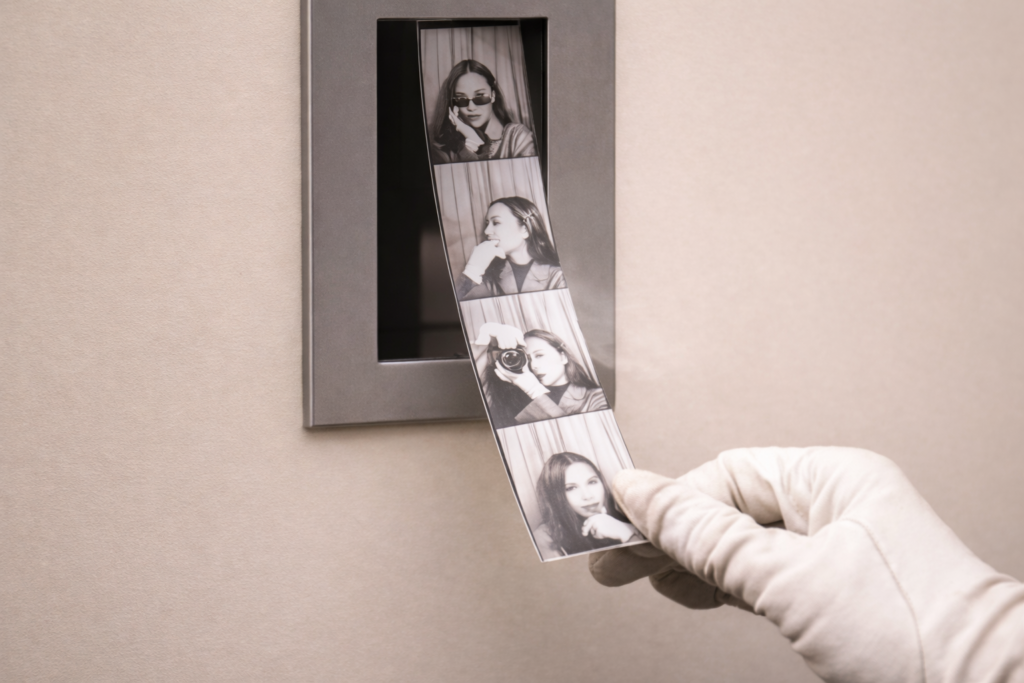
The Anemoia Device does not attempt to digitize scent or archive personal recollections. Instead, it explores how imagined memory can be constructed through multisensory interaction. The process begins with a printed photograph. Using AI-based image analysis and language models, the system interprets visual elements within the image and produces a short narrative perspective. Users then intervene, selecting a subject within the photo, a temporal context, and an emotional tone. Past or present. Intimate or distant. Comforting or uneasy.
These inputs are synthesized into a brief textual description, which is then translated into scent. The device draws from a deliberately limited library of fragrance oils. Each oil corresponds to abstract qualities rather than literal references. Woodiness suggests age or stability. Citrus signals immediacy or lightness. The oils are blended in precise quantities to produce a physical fragrance that accompanies the image.
Crucially, the goal is not accuracy. The scent is not meant to replicate a real place or a personal history. Instead, it constructs an imagined memory, one that feels emotionally coherent even if it never existed. In this way, the photograph becomes less of a document and more of a prompt. The viewer is no longer recalling the past, but participating in the creation of something new.
The project draws attention to a long-standing imbalance in how we treat the senses. Photography and visual culture have dominated how history is recorded and consumed. Scent, by contrast, has remained resistant to preservation. It is difficult to catalogue, hard to standardize, and deeply subjective. By pairing smell with photography, The Anemoia Device challenges the idea that memory must be visual to be valid.
There is also a subtle resistance embedded in the work. In an age where images are endlessly scrolled, compressed, and consumed at speed, this device insists on pause. The photograph must be printed. The interaction is tactile. The scent unfolds slowly. Meaning is not delivered instantly but assembled through choice and interpretation.
The system is not without its constraints. A small fragrance library limits specificity. Emotional tone relies on user input rather than machine understanding. Associations will differ from person to person. Yet these imperfections mirror memory itself. Fragmented, subjective, and often shaped as much by imagination as by fact.
Beyond the lab, the implications are clear. Fashion, art, and luxury have increasingly turned to multisensory experience as a way to build emotional connection. From scented exhibitions to immersive retail environments, the industry understands that memory is rarely one-dimensional. The Anemoia Device extends this thinking into more speculative territory, suggesting a future where even personal images may become sites of sensory storytelling.
ALSO READ: #BUROSPOTLIGHTS: EGYPTIAN ARTIST AIDHA BADR.