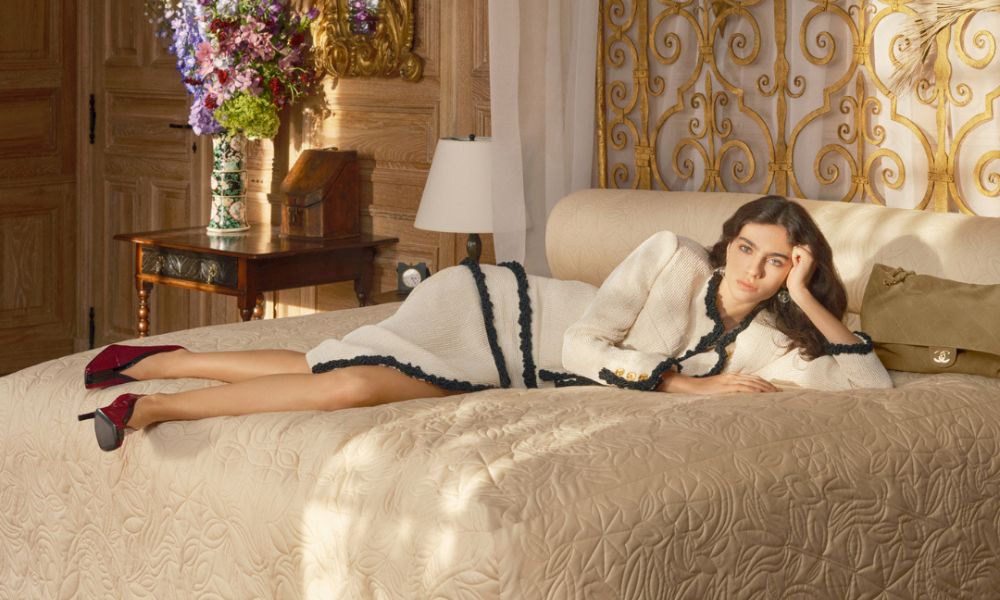
Perched above the Mediterranean in Roquebrune-Cap-Martin, Villa La Pausa has long held the quiet authority of a place designed for thought. Built in 1928 as a retreat from Paris and named for the pause it promised, the house was where Gabrielle “Coco” Chanel withdrew to work, host, and observe. It was never a site of withdrawal in the romantic sense. It functioned as an extension of her mind. It was a site of exchange. Ideas moved freely through its rooms, shaped by conversation, contradiction, and creative restlessness. For Matthieu Blazy, choosing La Pausa for his first campaign as creative director of Chanel is less an act of reverence than a clear statement of intent.
That history makes La Pausa a strategic choice for Matthieu Blazy’s first campaign as creative director of Chanel. A debut campaign inevitably invites scrutiny. It is read for clues, direction, and ideology. Rather than announce his arrival through overt disruption, Blazy situates his vision within the conditions that once shaped Chanel herself.
Photographed by Alec Soth, the Spring 2026 campaign unfolds with quiet assurance. Soth’s lens avoids drama and excess, favoring moments that feel observational rather than staged. Models move through the villa’s rooms, captured mid-motion on staircases, reclining on beds, or framed in doorways. Outside, in the courtyard, one model climbs an olive tree. The image directly recalls a series of black-and-white photographs from the late 1920s showing Chanel herself climbing the same tree alongside friends. It is a reference that operates less as nostalgia and more as alignment, connecting past and present.
The villa’s history looms lightly over the images. La Pausa once hosted figures such as Salvador Dalí, Luchino Visconti, and Colette, drawn by Chanel’s curiosity and her refusal to compartmentalize creativity. That spirit of exchange is subtly echoed in the campaign’s ensemble cast. Models associated with Blazy’s debut collection for the house reappear.
Clothing, however, remains central. The campaign advances Blazy’s interpretation of Chanel’s enduring masculine-feminine tension, a dialogue that has defined the house since its inception. Androgynous tailoring sits alongside embellished day suits and eveningwear, without hierarchy or rigid distinction. The clothes suggest movement and adaptability. They invite composition rather than prescription, reinforcing Chanel’s long-held belief that garments should accommodate the wearer’s life, not constrain it.
ALSO READ: WHO IS HUDSON WILLIAMS AND WHY IS THE FASHION WORLD OBSESSED WITH HIM RIGHT NOW?