At Buro247 Middle East, we are committed to showcasing and celebrating the extraordinary talent in the Arab world. With our column, #BuroSpotlights, we bring you stories of pioneering artists, innovative designers, tech trailblazers, cinematic visionaries, sports stars, and more.
This week, #BuroSpotlights Syrian Artist Besher Koushaji.
Besher Koushaji paints as if memory itself were a living material. His canvases are shaped by longing, loss, and the quiet determination to preserve what time and distance try to erode. For a Syrian artist who has spent more than a decade on the international art circuit, painting is a way of holding onto home.
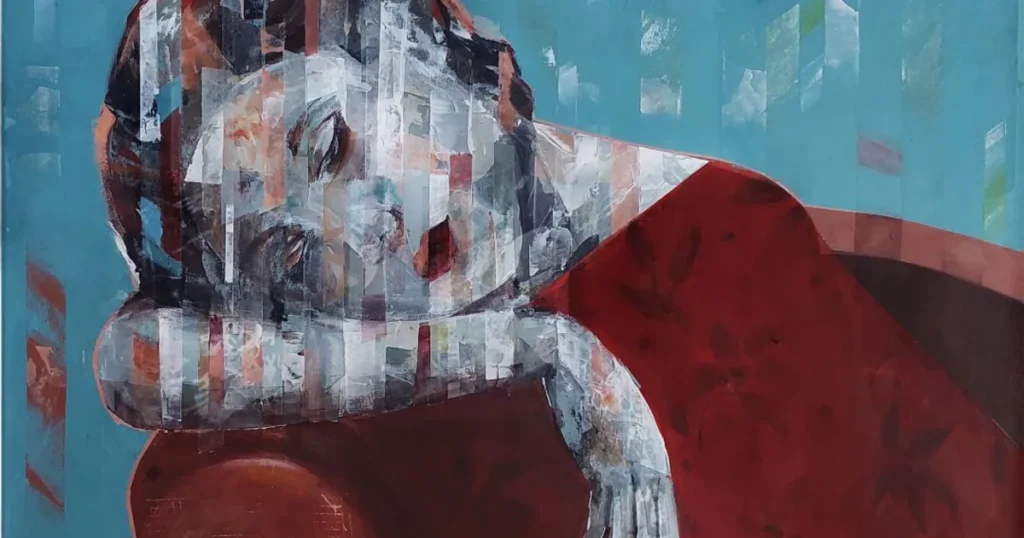
Portraits of women dominate his practice, captured in ordinary moments that feel suspended in time. These figures are not presented as complete images. Instead, they are fractured by intersecting lines, segmented planes, and geometric divisions that disrupt the surface and invite closer inspection.
Those interruptions are deliberate. The women in Koushaji’s work stand in for loved ones left behind in Syria, while the sharp divisions echo architectural details drawn from his homeland. Memory, here, is never smooth or linear. It is layered, interrupted, and constantly reshaped. By altering and fragmenting the figure, Koushaji reflects the tension between remembering something as it was and accepting how it changes over time.
His background in graphic design is unmistakable. There is a clarity to his compositions and a strong sense of balance, even when the image feels deliberately unsettled. Cultural references are woven into this visual language rather than placed on top of it. Arabesque patterns emerge subtly within the work, not as decorative gestures but as structural elements that anchor the painting to a wider cultural memory. These references sit comfortably alongside a contemporary visual sensibility, giving the work both depth and immediacy.
Color plays a measured but powerful role. Bright palettes often appear alongside muted tones, creating a dialogue between warmth and restraint. Flowers and fruits recur across his canvases. These are not ornamental details. They are symbols tied to ritual, domestic life, and resilience. They act as quiet witnesses, carrying emotional weight without overt sentiment.
At the center of many works stands the female figure, composed and self-contained. She is silent but never passive. In Koushaji’s paintings, women embody endurance and continuity, holding space for memory while refusing to collapse under its weight. They function as anchors across past, present, and future, suggesting that survival is not always loud or dramatic. Sometimes it is simply steadfast.
ALSO READ: BURO PRESENTS: TIME, DIRECTED – TAG HEUER THROUGH THE LENS OF ELIE FAHED.